

Conversion Guide - Existing Building into an Ambulatory Surgery Center
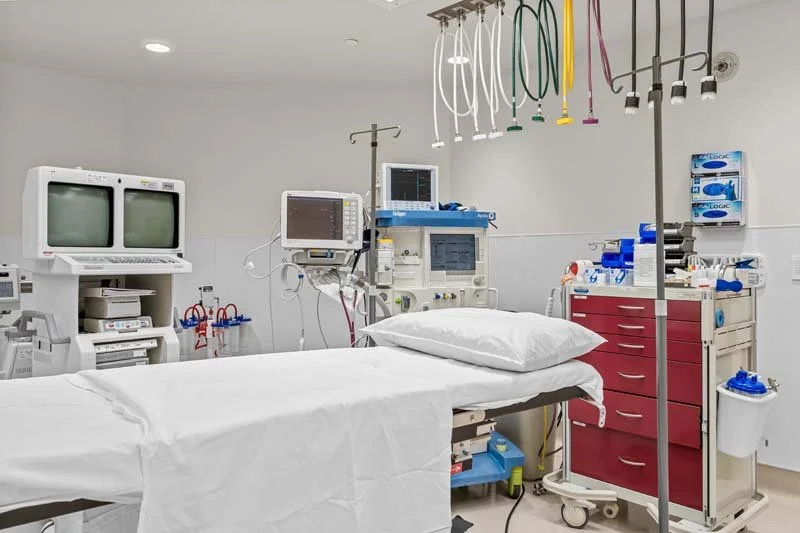
An Ambulatory Surgery Center (ASC) is, in many ways, a highly specialized miniature hospital. Although ASCs typically support less complex and less invasive surgeries, they are still modern, high-acuity clinical environments. They are required to meet rigorous standards and be equipped for safe, sterile and intensive operations. As a result, a building functioning as a medical clinic may not be suitable as an ASC, and upgrading a facility to an ASC introduces stringent requirements for the building shell and systems. State licensure, accreditation, and Medicare standards also dictate their own expectations, including room sizes, pressurization relationships, and system redundancies. While an existing building can often be brought up to compliance, it is critical to understand whether it is feasible and how much work will be required to achieve it.
Even an experienced design team can be limited by a facility that is fundamentally unsuited to support a surgery center. One of the first essential steps is having a clear understanding of the building’s capacity and its constraints. The feasibility for this conversion depends on the intended program of the future facility: How many operating rooms are planned? What level of power consumption will be required? Can the required HVAC, medical gas systems, and emergency power physically fit within the structure? A knowledgeable professional can evaluate these factors and determine whether a building is a strong candidate for ASC conversion or whether the process will become an ongoing struggle against the limitations of the facility itself.
Pre-Conversion Factors to Understand
Zoning, Use, and Occupancy Limits
Confirm that ASC use is allowable and whether changing occupancy or intensity will trigger additional life safety or site upgrades. This is a front-end filter before spending time and resources on deeper studies.
Floor-to-Floor Heights and Above-Ceiling Space
Upgrades will almost always take up more room. Plenum depths show whether there is realistic room for OR-level ductwork, med gas, and utilities without dropping ceilings uncomfortably low or impacting equipment, that is when cost-benefit issues begin to appear.
Structural Capacity and Load Paths
Equipment and utility requirements might reveal a need to install heavy rooftop units, generators, C-arms, and OR booms. Not every area of the building may be able to handle these high-load items.
Existing HVAC Systems and Distribution
Air-change and pressure requirements may lead toa reassessment of your HVAC systems. Depending on the existing system, this could simply mean some selective upgrades or an entirely new system.
Electrical Service Size and Distribution
Verify incoming service size, panel capacities, and spare spaces. Determine early if the building can accommodate ASC power demands and separate essential branches, or if service upgrades and new risers will be required.
Emergency Power Feasibility
Potential generator or backup batteries will need to be placed and stored. Ideal locations will rely on the placement of exhaust paths and structural support. Some roofs may not be able to support a generator installation, which will need to be corrected.
Plumbing Infrastructure and Slab Conditions
Understand where existing restrooms, risers, and wet stacks are located, and what the slab construction is. Cutting and trenching for new exam, OR support, and sterile processing plumbing can be a major cost driver.
Fire Protection, Fire Rating, and Egress
The building needs to be fully sprinklered. Fire exit plans need to match the layout of the facility. Changes to a fire protection plan can add complexity to an otherwise simple project.
Vertical Circulation and Shafts
Stairs, elevators, and shafts must be suitable for the center’s expected capacity. This space can also be explored for potential reuse for ducts, med gases, and wiring.
Existing Conditions, Hazmat, and Prior Remodels
Older buildings can present with issues like asbestos, lead, water damage, and undocumented modifications. This can present a roadblock for any demolition, phased construction, or permitting.
Site Access, Parking, and Drop-Off Geometry
The facility becomes unusable if it lacks a reliable way for patients to gain easy access to the parking lot and entrance. The site needs to facilitate drop-off, parking, and, depending on the facility’s specialization, ambulance and bariatric access.